Discovering “Hidden Gems” in Small & MidCap
We are purely bottom-up, fundamental stock pickers. Every holding in every portfolio starts as an idea generated, researched and challenged inside this building.
You get what you pay for in life
We would far rather pay a fair price for a superior business than a cheap price for a poor one. Buying low-quality companies because they look statistically inexpensive is, in our experience, a reliable way to lose money slowly.
Quality Growth is not a style label we adopted when it became fashionable. It is the logical consequence of what we look for: businesses that earn a high return on the capital they employ, in markets that grow structurally, with balance sheets strong enough that they never have to ask anyone's permission to keep going.
Beating the fade
Standard corporate finance assumes that high returns on capital “fade” quickly towards the cost of capital as competition arrives. Our research shows that genuinely high-quality companies sustain those returns for far longer than the models predict. That gap between what the market assumes and what actually happens is where our returns come from — and it is why our ideal holding period is forever.

What a “Hidden Gem” looks like
Every candidate is measured against the same checklist, whichever market it is listed in. Companies that fail on quality never reach a valuation discussion.
Simple and understandable
A transparent business model we can explain in a paragraph. If we cannot describe how the company makes money, we do not own it.
Consistently profitable
A track record of profitability through a cycle, supported by a strong balance sheet with low or no net debt.
Niche operator, growing market
A specialist positioned in a market with secular rather than cyclical growth — the tailwind should do some of the work.
Clear market leadership
Substantial barriers to entry and genuine pricing power: the ability to raise prices without losing the customer.
High, stable margins
High and stable operating margins and a high return on invested capital (ROIC) sustained over many years.
Management we trust
Proven, aligned management teams with meaningful personal ownership and a record of doing what they said they would do.
Rigorous, in-house, and entirely our own
There are over 2,000 listed European SmallCap companies and roughly 11,000 companies in the global SMID universe. Narrowing that down is a full-time job for a large team.
Proprietary idea generation
Screening, sector mapping and company visits generate every idea internally. We do not depend on sell-side notes, and we do not pay for research we could do better ourselves.
Fundamental analysis & site visits
Thorough modelling of the business, its supply chain and its competitive position — followed by a mandatory visit to the factory or headquarters before any capital is committed.
Investment Committee scrutiny
Every idea is formally vetted and challenged by the Montanaro Investment Committee. A recommendation has to survive the room before it survives into a portfolio.
Valuation & disciplined execution
A consistent valuation framework and explicit buy and sell criteria. Quality gets us onto the list; valuation decides when we act.
Why the asset class stays inefficient
Smaller companies receive little or no sell-side coverage, and the coverage that does exist is thin and inconsistent. That structural inefficiency — alongside the long-term “SmallCap Effect” — is the opportunity we have built the entire firm around exploiting.

We buy businesses, not tickers
Because we intend to hold for many years, our relationship with a company does not end at the point of purchase. We engage constructively with management on strategy, capital allocation, governance and sustainability, and we vote at 100% of portfolio AGMs.
- Direct, regular access to the management teams of the companies we own
- Constructive private engagement in preference to public confrontation
- Published Shareholder Engagement Policy and Voting Policy, with proxy voting summaries and rationales
- Escalation where engagement does not produce change, up to and including divestment
Sustainable companies offer the best potential for sustainable returns
That is not a marketing position — it is an investment conclusion. Companies that treat their people, their supply chains and their environment carelessly tend to be the ones that eventually surprise their shareholders.
Our proprietary four-pillar framework is applied at every stage of fundamental research, on every company we consider, in every strategy we run — not only in the funds with “sustainable” in the name.
The framework combines a hard exclusionary screen with detailed environmental, social and governance assessment. Where a company fails the screen, no amount of valuation appeal will bring it back.

Pillar one: Ethical restrictions
We will not invest in any business deriving 10% or more of its revenue from:
- Fossil fuel exploration and production
- Tobacco manufacturing and distribution
- Alcohol manufacturing and distribution
- Controversial weapons, including cluster munitions, landmines and chemical or biological weapons
- Gambling operators and casinos
- Adult entertainment and pornography
- High-interest rate and predatory lending
- Animal testing, strictly excluded unless mandated by healthcare regulation
Pillar two: Environmental policy
- Verification of science-based decarbonisation pathways (SBTi alignment) and Net Zero 2050 commitments
- Assessment of Scope 1, 2 and 3 emissions intensity, energy efficiency and the transition to renewables
- Scrutiny of water consumption, hazardous waste management, circular packaging and plastic reduction
- Biodiversity risk assessment across vulnerable ecosystems, aligned to the TNFD
Pillar three: Social policy
- Human rights protections across global supply chains, with zero tolerance for child or forced labour
- Employee health and safety standards, retention rates and fair living wages
- Workplace diversity, gender pay gap transparency and female leadership representation
- Corporate tax fairness and anti-bribery and anti-corruption compliance
Pillar four: Corporate governance
- Board independence, separation of Chair and CEO, board diversity and director tenure
- Executive remuneration aligned to long-term shareholder value and ESG performance
- High insider and management equity ownership
- Active proxy voting at 100% of portfolio AGMs, with constructive stewardship throughout
Independently recognised
Sustainable Investment Fund Management Group of the Year
Investment Week, 2025.
ESG Champion of the Year
Investors’ Chronicle & Financial Times, 2023 and 2024.
Best Impact Report
Pensions for Purpose, 2025, for the Montanaro Better World Fund.
Our policies, published in full
We ask the companies we own for transparency. These are the documents that hold us to the same standard.
Frameworks & policies
- Montanaro ESG Handbook 2026
- Corporate CSR Policy
- Climate Change Policy
- Modern Slavery Statement 2026
- Shareholder Engagement Policy
- Voting Policy, with published proxy voting summaries and rationales
Reports & assessments
- UN PRI Annual Assessment and Transparency Reports, 2017–2025
- UK Stewardship Code Report 2026
- TNFD Biodiversity Report
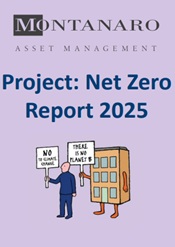
- Deep Dive #14 — Net Zero Carbon: 2025, by Kate Hewitt
- Better World Fund Annual Impact Reports, 2022–2024
- SDR and TCFD product reports for our listed trusts
Net zero progress
As reported in Deep Dive #14, financed Scope 1 and Scope 2 emissions are down 87% against our 2019 baseline across all portfolios, SBTi-aligned assets have increased to 43.4% of in-scope AUM, and our reporting is fully compliant with ISSB standards.
Where our impact strategies invest
The Better World strategies invest in Small & MidCap companies whose core products and services deliver measurable positive outcomes, mapped to the UN Sustainable Development Goals.
- Environmental Protection
- Green Economy
- Healthcare & Wellbeing
- Future of Education
- Social Cohesion
One philosophy, several ways to access it
Open-ended UCITS funds, two London-listed investment trusts and segregated institutional mandates — all run by the same team, to the same process.